
A Christmas Eve party can cost nothing but a deck of cards or run to a Santa suit rental and a champagne flute tree stocked with bubbly.
The deciding factor is how many children under 10 are on your list: three or more justifies Santa’s Grotto, while an adults-only group leans toward cocktails with lit sparklers or a wreath workshop where dried orange slices last into January.
1. Ugly Christmas Sweater Party

An ugly sweater party works because the costume is the entertainment. Guests arrive already performing, and the worst knit wins the most attention.
Light-up elements or small speakers sewn into the fabric turn a static joke into something that moves through a room.
The host’s only real job is setting the stakes. A category for DIY builds keeps crafters invested; a category for found atrocities lets the less committed play too.
Small prizes help, but public voting by noise level costs nothing.
I’d run this for a group where half the guests already know each other. Strangers in ridiculous sweaters break ice faster than strangers in regular ones.
2. Wreath Workshop

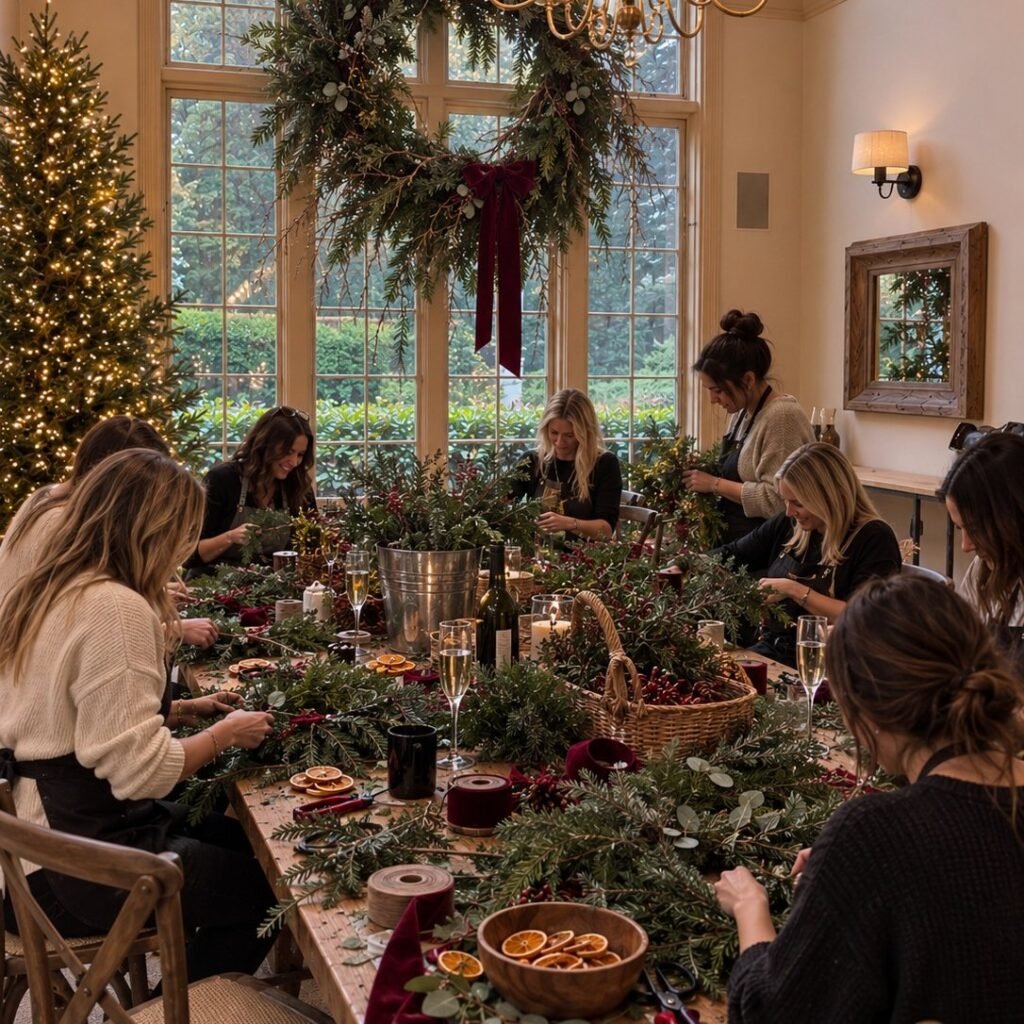
A wreath workshop gives guests something to do with their hands while they talk, which matters more than the finished object.
A long table lets guests spread out branches and dried citrus without overlapping elbows; that spacing is what lets conversation flow.
Greenery, wire frames, and ribbon cover the basics. Dried orange slices, visible in the finished wreath hanging behind them, add color that lasts through January without refrigeration.
Guests leave with something that reads as handmade and expensive even when the materials ran cheap per person.
This suits an afternoon slot where the light fails and no one expects a full meal.
3. Christmas Eve Game Night

Game night scales to whatever space and competitive energy the group already has.
A full production setup with blue podiums and a TV running the Family Feud logo works, but the same idea holds with a deck of cards and a printed trivia sheet.
Board games work for groups that split into pairs or fours. Trivia or a DIY game show pulls everyone into one conversation, which helps when the guest list mixes friend groups that do not otherwise overlap.
The host’s real decision is whether to referee or play; I referee, partly because I own the games and partly because it lets me manage the snack flow.
Add food that does not require a fork. Finger foods keep hands free for cards and controllers.
4. Christmas Brunch

Christmas brunch moves the gathering to morning, which changes who can come and how long they stay. A lace cloth that reads formal and plaid placemats that pull it back toward casual creates the whole mood.
A strata or baked egg dish feeds everyone at once and frees the host from the stove. Cinnamon rolls, even store-bought ones rewarmed, fill the kitchen with a smell that does half the hosting work.
The berry arrangement and dried orange slices overhead give height without blocking faces across the table.
I’d schedule this for late morning, when people are hungry but still have the full day ahead. Guests with small children can come early; guests who were out late the night before can still make it.
5. Santa’s Grotto

Hiring Santa, or convincing a willing friend to suit up, turns a regular party into something children measure against every other Christmas they have had.
A doorway dressed with enough lights and a wreath becomes a set piece itself; Santa stands in it rather than wandering the room, which keeps the interaction controlled and brief.
Small gifts or candy canes to distribute give Santa a reason to end each visit. A photo spot, even just the decorated door, lets parents capture the moment without chasing a moving target.
The cost is the suit rental and the performer’s time, or one very good friend. I’d only add this if the guest list includes more than 3 children under 10; otherwise the adults outnumber the believers and the energy goes flat.
6. Christmas Afternoon Tea

Afternoon tea imposes a structure that makes hosting easier: small plates, set times, a menu that does not change. A spread running from finger sandwiches through scones to ornament-shaped pastries controls pacing without the host announcing courses.
Cranberry scones and cinnamon-spiced tea fit the season without requiring a full kitchen redesign. The sandwiches should be made close to service, but everything else can sit out under cloth or in a warming drawer.
This format works best when the guest list is fixed and known. Tea is not a drop-in event; portions are calculated, seats are set, and a late arrival throws the rhythm.
I’d send the invitation with a start time and a clear window, then let the food signal when the afternoon is ending.
7. Pajama Party

Matching pajamas turn a living room into something that feels planned without requiring a venue or a rental.
For a Christmas Eve version, I’d pick one pattern and ask guests to show up in it, or buy a set for the regulars and keep a few extras in medium and large for last-minute arrivals.
Hot chocolate and something sweet on a tray keep the menu simple. The whole setup works for groups of 4 to 12 in any home with a couch and floor space.
8. Festive Cocktails with Sparklers

Sugar-rimmed glasses and lit sparklers turn a standard cocktail into a photo guests actually take.
The orange drinks I saw sat on a wooden board with cinnamon sticks, clementines, and greenery with fairy lights; the sparklers did the work of centerpieces.
For timing, light sparklers just before handing drinks out, not for a batch sitting out. Dried fruit garnishes hold up longer than fresh if the drinks wait before serving.
I’d limit sparklers to a small batch of drinks at once; they need attention in a crowd. Best for hosts who enjoy being at the bar rather than circulating away from it.
9. Cozy Winter Dining Setup

Faux fur throws on chairs signal "stay awhile" faster than any centerpiece.
The dining hall I saw had them over every seat, plus wreaths hung high and greenery low, so the eye traveled up and down instead of stopping at one level.
Layer textures without letting the colors compete. White fur against dark wood, greenery that reads as one deep tone, and glass or metal catching light somewhere: that’s the palette.
Check your chairs first. Slipcovered or rounded backs hold throws better than narrow upright ones, which slip and need tying.
10. Champagne Flute Christmas Tree

A mini tree built to hold champagne flutes turns one drink service into the whole decoration.
Flute trees work best with built-in holders all over, filled with something bubbly, and a red velvet bow on top; set it on a kitchen island where people naturally gather.
I’d fill flutes just before guests arrive; the liquid weight steadies the tree, but early pouring risks warming or spilling.
Best for hosts who want the bar to be the statement and skip a separate cocktail table. A kitchen island or wide sideboard is required; a narrow surface tips too easily.
11. Tiered Holiday Cocktail Tower

A tiered stand for cocktails solves the problem of where everyone stands while drinks get poured.
A gold tower holding coupe glasses of deep red liquid, each garnished with white foam and berries, plus green velvet bows on the stand itself and evergreen branches around the base, gives a finished look without much effort.
For a home version, any tiered dessert stand works. Mix one batch of a single cocktail rather than offering choices; the visual unity is the point.
Foam tops need practice or a small frother; berries and a thin ribbon are the easier path.
I’d set this on a counter, not a table guests sit at, so the tower stays visible and untouched until announced. Suits hosts who want the drinks to be the opening act, not background.
12. Festive Appetizer Buffet Spread

A red tablecloth and every appetizer you can fit onto it reads generous even when no single dish is elaborate.
A buffet of shrimp with lemon, meatballs, fried bites, chips, and multiple dips down the center lets guests serve themselves and keeps the host from plating.
Vary the shape and temperature of what you put out. Something hot in a slow cooker or warming tray, something cold on ice, something crunchy, something scoopable.
Buy the fried items and the shrimp; make one dip yourself if you want a homemade moment.
Plan generously per person per hour, and set plates at one end so the line moves one way. This format trades elegance for ease; choose it when you’d rather replenish than announce courses.
13. Winter Wonderland Table Setting

Cool white light changes everything about how a table reads after dark. The silver trees and crystal catch it like frost; the polar bear grounds the scene so it does not float away into formality.
For a home host, this is easier than it photographs. Battery-operated LED strips hide under the table edge or run down the centerpiece stem; they cost less than a takeout pizza online, with no cords to trip over.
White roses last one evening cut short, but white carnations or even good silk stand in without apology.
The tradeoff is the chill. This setting suits guests who want to feel somewhere else for an hour, not hosts aiming for the warm chaos of family Christmas.
Add candlelight if you need both.
14. Festive Signature Blue Cocktail

A blue cocktail reads as effort without requiring a stocked bar. The color comes from blue curaçao, which tastes like orange peel and sugar; the sugar rim and rosemary do the real work of making it look considered.
Rim the glass with coarse sugar while it is still wet from a lime wedge, and the frost holds through the first few sips. The cranberries are decorative, not functional; they sink, and a guest who bites one gets bitterness.
I would skip them for a circulating party and keep the rosemary, which smells right when someone lifts the glass.
A bottle of curaçao sits in cabinet corners most of the year. One bottle covers a small group for the night with limes left over.
15. Tinsel Christmas Tree Dress

Tinsel on clothing sheds. That is the first thing to know.
The second is that no one forgets the person who arrives as the tree.
A plain green dress, hot glue, and 2–3 packs of silver garland from the drugstore get you most of the way.
The ornaments need loops or wire; sew them through the dress seams, not the glue, or the weight pulls free by the second room. Battery lights tangle less if you pin the battery pack at the hip and work upward.
This trades away any hope of sitting comfortably or brushing past furniture without rustling. I would wear it to a standing party of friends who photograph everything, never to a dinner where I was also cooking.
Setting a Theme
A theme only works if it makes decisions for you. "Winter Wonderland" tells you to buy white and silver; "retro ski lodge" sends you toward plaid and pine.
Pick one that narrows your options, not one that opens them up.
The dress code is part of this. If guests need a specific item, ugly sweater or matching pajamas, say so on the invite and give them time to find it.
A theme without a dress code leaves half the room in red and green while the other half ignored the prompt.
Food and Drink
Mulled wine carries its own recipe: allspice berries, cloves, cinnamon sticks, and fresh ginger slices. You can batch it an hour before guests arrive and keep it warm on the stove; the smell does part of the hosting.
Mince pies and eggnog cocktail fill out a classic spread without requiring a full kitchen. Store-bought mince pies warm fine in the oven, and eggnog mixes from carton plus rum if you are not starting from eggs.
One homemade element, the mulled wine or a single dip, covers the rest.
Guest List and Invites
Match the invite design to the theme so guests know what kind of evening this is before they reply. A paper invite with a wreath signals afternoon tea; a text with a sweater emoji says something else.
Make the RSVP method the easiest part. A reply to the text, a checked box on the platform you already use, a date by which you need the count.
Guests who have to hunt for how to respond often do not.
Entertainment and Games
Interactive entertainment only works if the host is willing to manage it. A quiz needs a reader and a scorer; a gift exchange needs rules explained and enforced.
Pick what you want to run, not what photographs well.
Live music sounds better on paper than in a living room where no one can talk over it. A playlist you control, volume adjusted per song, keeps the energy where you want it.
Quizzes and gift exchanges pull people together; background music lets them split apart. Choose based on whether your guest list already mixes or needs help.