
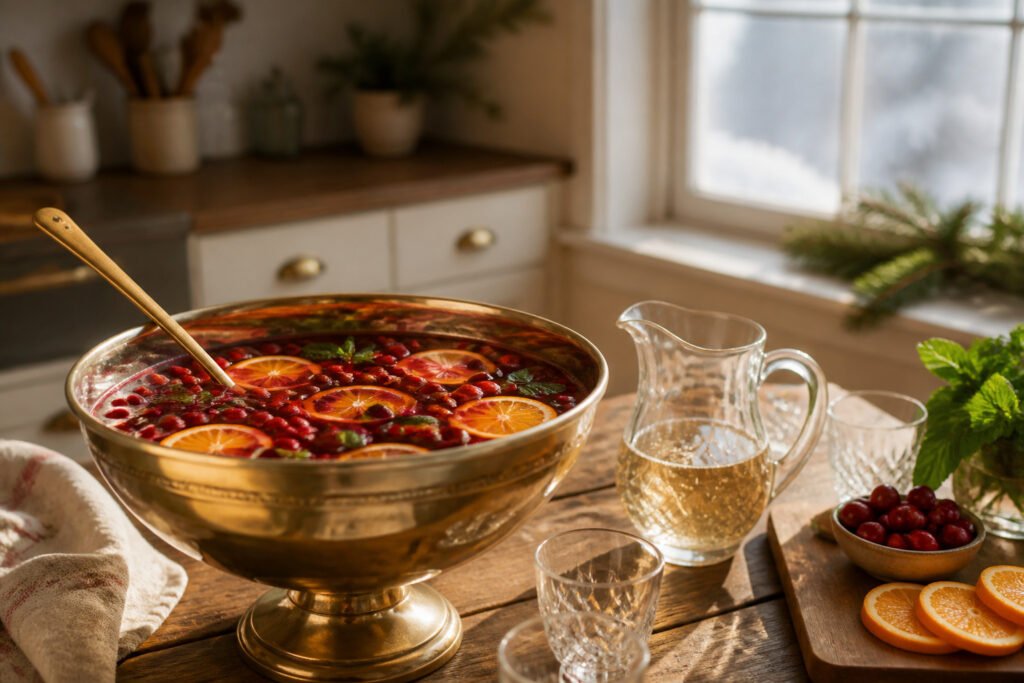
The most useful thing a host can know is that ginger ale belongs in the bowl the moment the doorbell rings, not twenty minutes before.
Pour it early and you will serve flat, syrupy punch by the time the first guest fills a cup.
That timing rule, learned from a party where the only fizz left was in the unopened bottle, applies to every recipe that follows.
The vodka-cranberry batch yields exactly six cups because that is what fits a standard small punch bowl without sloshing.
1. Vodka Cranberry Christmas Punch

Pomegranate juice does most of the work in this one. I blend 2 cups of it with 1 cup cranberry juice, 1 cup vodka, and ½ cup triple sec, then top it with 1½ cups ginger ale right before serving.
The batch yields exactly 6 cups, which is why I stopped there: it filled my small punch bowl with none sloshing over, enough for eight people to have one glass and a top-off.
The tart-sweet balance sits in that pomegranate-cranberry split. Straight cranberry juice would have been mouth-puckering; the pomegranate rounds the edges without adding sugar.
I float orange slices and a few rosemary sprigs on top, mostly so guests know it’s Christmas and not just Tuesday.
Ginger ale goes in last, after the base is chilled. Pour it early and you’ll be serving flat punch by hour two.
I learned that the hard way at a smaller gathering where the only fizz left was in the bottle I hadn’t opened yet.
2. Holly Jolly Christmas Punch

A single batch of Holly Jolly Christmas Punch fills a punch bowl with 24 servings, which is where this recipe starts to make sense for a larger crowd.
The base is 64 ounces of cranberry juice, two 46-ounce cans of pineapple juice, a 2-liter bottle of Squirt, and a 750 mL bottle of silver tequila. That volume matters.
At a party of thirty, one batch stretches with a light pour; at twenty, it is generous.
Squirt matters more than generic lemon-lime soda would. The grapefruit in it cuts through the pineapple and cranberry so the punch does not flatten into pure sweetness.
Other citrus sodas work, but they tilt the balance toward candy. The Squirt keeps some bite, and that bite lasts through a two-hour party better than I expected.
The carbonation does fade, as it always will, but the flavor holds.
Fresh cranberries and lime slices do the visual work. The limes also give guests something to squeeze if they want more acid.
I would not skip them, even though the recipe lists them as garnish. They are doing more than looking festive.
3. Easy Christmas Punch

This is the punch I end up making when I do not have time to think about it.
64 ounces of cranberry juice, 32 ounces of pineapple juice, and 32 ounces of ginger ale fill the bowl with something that reads as effort without requiring any. The color alone does the holiday work.
The yield lands right at 16 cups, which is the size that actually matches most living rooms. Smaller bowls leave people hovering, and the giant party recipes assume you own a rental hall.
Sixteen cups covers twelve to fourteen guests with refill room, or eight guests who keep their cups longer than they planned.
A 750 mL bottle of aged rum sits next to the bowl, optional in the truest sense. The best move is leaving the base non-alcoholic and adding two ounces of rum per cup for whoever wants it.
That way the one who drove gets the same drink as the one who did not. The rum adds warmth, but the pineapple and ginger ale already do most of that work.
For garnish, citrus wheels and rosemary sprigs float well enough to look intentional. Star anise is pretty until someone tries to drink around it.
4. Sparkling Pomegranate Punch

Bright winter citrus means fruit that still has acid in December, not the sweet summer stuff.
I reach for Cara Cara oranges and blood oranges, both in season through the holidays and sharp enough to cut through pomegranate juice without turning sugary.
The rind goes in too, sliced thin with a vegetable peeler so the oils surface once the liquid hits ice.
The sparkling component is prosecco or club soda, and it goes in last, right before the first guest fills a glass.
Carbonation lifts the pomegranate and citrus for maybe 20 minutes after opening, then the whole thing sits flat and reads as juice.
I learned that the hard way at a tree-trimming party where I pre-poured everything into a footed bowl an hour early.
The fix is simple: mix the pomegranate, citrus, and any spirits ahead, chill that base, then top with bubbles as you carry it out. If your crowd trickles in, split the batch and sparkle half at a time.
5. Spiced Cranberry-Orange Punch

Spiced cranberry-orange punch earns its spot at the table because it reads as special without reading as booze.
I build the backbone from 100% cranberry juice, Simply Orange, and a large can of pineapple juice, then add six mini cans of ginger ale for fizz.
Whole spices do the work vodka would otherwise do: a full jar of cinnamon sticks, star anise, and fresh rosemary steeped right in the bowl with a bag of fresh cranberries and two sliced oranges.
The whole spices release slowly; you taste clove and bark through the fourth cup, not just the first.
Skip the dry ice unless you know exactly how to handle it. A video walkthrough from Justine’s Kitchen shows the effect, but plain ice keeps the rosemary and orange slices visible and the host out of the ER.
What puts this in rotation for mixed crowds is the built-in customization. The base is fully spirit-free, so guests who avoid alcohol are not drinking the kid version.
Guests who want a hit can spike their own glass with triple sec or vodka, not the whole bowl.
The fruit and spice also sit well overnight, so one batch covers a whole weekend of drop-ins without the flat, oxidized taste that dooms citrus-heavy punches by day two.
6. Christmas Punch with Sherbet

Sherbet behaves differently than ice cream in punch, and the difference matters once the scoops hit the liquid.
Ice cream contains more butterfat, around 10 percent or higher, which leaves a slick film on the surface and dulls the color as it melts.
Raspberry sherbet runs closer to 1–2 percent milkfat, so it breaks apart into clean, bright ribbons instead of pooling into opaque clouds.
I have watched a bowl of punch turn from ruby to pale rose in about 10 minutes when the scoops were too small and too many; six to eight generous scoops for a full recipe holds the color longer because the cold mass melts slower and the ratio of sherbet to liquid stays balanced.
The color shift is part of the appeal, not a flaw to hide. The punch starts one shade and ends another, and guests seem to like the cue that the drink is alive and changing.
If you want the brighter stage to last through the first round, freeze the scoops hard and add them just before people arrive.
Room temperature liquid pulls the color out fast; chilled base buys you 5–10 minutes of that vivid raspberry streak. For punch that stays pretty past the first ladle, start with cold ingredients and oversized scoops.
Garnishes That Actually Work

Garnishes turn a punch bowl from a drink dispenser into the thing people photograph.
Recipes never say how much to buy, and grocery store guesses are almost always stingy, so I figure about a cup of garnishes per gallon of punch and adjust from there.
For a standard batch serving about twelve, one whole orange and one whole lemon give you enough slices to float on top and tuck down the sides where the glass curves.
That visual depth matters more than piling everything in the center. Five star anise pods was the count that worked for me; more than that and the liquorice note started elbowing the fruit out of the way.
A handful of fresh or frozen cranberries, maybe fifteen or twenty, reads as abundance without cluttering the ladle’s path.
Rosemary sprigs are where I used to overdo it. Two or three, stripped of their woodiest lower stems, give that winter-forest scent when someone leans in to pour.
Frozen cranberries and small rosemary sprigs set into ice cubes are the move for keeping temperature down, but I limit those to one tray’s worth per bowl.
Too much ice ruins the whole thing; once it melts past a certain point you are drinking cranberry water.
Frozen pineapple rings were a late addition I borrowed from a punch that called for pineapple juice. They sink, which is fine; the slices act as a visual anchor at the bottom and guests fork them out like cocktail snacks.
Two rings, quartered, is plenty.
The real measurement is not cups or counts. It is whether a guest can describe the bowl in one sentence afterward.
Citrus, red berries, something green: that three-color rule fits in a glance, and a glance is usually all the party allows.
Make-Ahead Timing

Juice mixtures hold fine for a day or two in the refrigerator. The ginger ale does not.
I learned this the hard way at a party where I added it twenty minutes before anyone arrived, thinking I was being efficient, and by the time the first guest poured, the punch had gone flat and syrupy.
Add carbonation right before serving, no earlier.
The timeline I use now: mix the cranberry juice, pineapple juice, and any spirits the night before, chill everything, slice citrus and prep garnishes separately. About thirty minutes before guests arrive, combine the juices in the bowl.
The moment the doorbell rings, pour in the ginger ale, add garnishes, and done. Leftover punch keeps two to three days refrigerated, though it will not regain its fizz.
Alcoholic and Non-Alcoholic Versions

Most recipes online gesture at a non-alcoholic version without spelling out the swap. The cranberry-pineapple-tequila punch from Inspired by Charm, for instance, just says to omit the tequila and Squirt.
What actually works is replacing the 24 servings’ worth of tequila with an equal volume of sparkling grapefruit juice, then swapping the Squirt for plain club soda so the drink doesn’t turn candy-sweet.
Double the ginger ale is the move A Couple Cooks suggests for their rum-based Christmas punch, and it holds: the extra fizz carries the same celebratory sting that alcohol would have provided.
For the pomegranate sangria-style punch Cravingsomecreativity builds around triple sec and vodka, the conversion is pulp-free orange juice for the triple sec, skip the vodka entirely, and freeze extra pomegranate seeds into the ice ring so the base doesn’t dilute while it chills.
Guests who want alcohol can spike their own glass with 2 ounces of rum ladled in after pouring, which A Couple Cooks recommends as a way to serve one bowl instead of two.
I find this works better in practice than parallel bowls, which always leave the alcoholic one dangerously low and the dry one barely touched.
Two pitchers marked with different ribbon colors, one with a measured rum float added per cup, keeps the math honest and the line moving.
Serving Sizes and Per-Guest Math

A recipe card that says 24 servings usually means 24 small cups, about 5 to 6 ounces each. I count on one serving per guest for a two-hour party, because people refill less often than hosts fear and ice melts into the volume.
The Holly Jolly Christmas Punch yields 24 servings from roughly 222 ounces of liquid, which at 6 ounces per cup gives you 37 cups total; the gap is ice displacement and the foam from the Squirt.
For per-glass cost, I add the shelf price of the cranberry juice, pineapple juice, tequila and soda, then divide by the serving count the recipe promises. That is the floor.
I add 15% for ice, garnishes and the cup itself, then round up to the nearest quarter.
If the store-brand cranberry juice is on sale, I run the math both ways and buy whichever keeps me under $1.50 per guest for a non-alcoholic punch, $2.50 with spirits.
My buy-versus-make rule is simple: if a pre-made cocktail base costs less than my calculated per-glass cost plus 20 cents for the control I lose over sweetness, I buy it.
The 20 cents covers dialing the recipe back with extra juice or ice. For Christmas punches, the fresh juices usually win on price; the exception is when a two-liter of already-citrus soda is cheaper than mixing seltzer and lemon juice myself.
I skip the exception. The soda is flat in an hour.
Frequently Asked Questions
Can I make Christmas punch non-alcoholic?
Yes. Leave the base non-alcoholic and set spirits next to the bowl so guests add their own.
For a fully spirit-free batch, replace tequila with sparkling grapefruit juice and swap Squirt for club soda, or double the ginger ale to keep the celebratory fizz.
How many people will Christmas punch serve?
It depends on the recipe. The Vodka Cranberry Christmas Punch yields 6 cups, enough for 8 people with one glass plus a top-off.
The Holly Jolly Christmas Punch makes 24 servings. The Easy Christmas Punch lands at 16 cups, sized for 12 to 14 guests with refill room.
What kind of tequila should I use for Christmas punch?
A medium-range silver (blanco) tequila works well. Decent quality complements the fruit juices better than a budget bottle, though nothing fancy is required.
Vodka or rum substitute fine if tequila is not your preference.
Can I make Christmas punch ahead of time?
Mix juices and spirits the night before and chill them, but add anything carbonated right before serving. Ginger ale or prosecco goes flat within about 20 minutes of pouring; pre-mixing it leaves you with syrupy juice by the time guests arrive.
What is a good party punch?
A good Christmas party punch balances tart and sweet, keeps its fizz through the first hour, and scales to your crowd.
The Easy Christmas Punch (cranberry, pineapple, and ginger ale) works when you need something fast; the Holly Jolly Christmas Punch stretches to 24 servings for larger groups.
What Christmas drink is known as milk punch?
Milk punch is a traditional Southern drink made with bourbon or brandy, milk, sugar, and vanilla, served cold and clear after curdling and straining.
What are some popular drinks for Christmas?
Popular Christmas drinks include mulled wine, eggnog, hot buttered rum, and fruit punches built on cranberry or pomegranate. The punches here add ginger ale or prosecco for fizz, and garnishes like rosemary, citrus wheels, and fresh cranberries for holiday color.
How to make punch for Christmas?
Start with a tart juice base like cranberry or pomegranate, round it with pineapple or orange juice, add spirits if you want them, and top with ginger ale or prosecco at the last minute.
Chill the base ahead, garnish with citrus and something green, and serve over ice.