Middle names for Addison are a decision about rhythm, not just style.
The three-syllable first name pairs cleanly with a single sharp beat like Grace or Mae, but runs into trouble when the middle starts with the same hard A sound, turning Addison Adalyn into something close to a stutter.
Saying the full name aloud is the test most people skip, and it matters more than origin research or spelling variations.
Single Syllable Classics

A three-syllable first name like Addison pairs cleanly with a single-syllable middle, and Mae, Ruth, Rose, Grace, and Claire show up often enough in real use that they have become the default short classics.
The rhythm works because the stress falls on the first syllable of Addison, then resolves on the downbeat of the middle name: AD-di-son MAE.
Saying the combination aloud is the test most people skip, and it matters more than spelling variations or origin research.
The BabyCenter threads suggest Grace gets called a filler name, but it still sounds nice, and a middle name is mostly just for graduations anyway.
Claire was the first name that came to one parent’s mind, and Paige got paired directly with Addisyn in the same thread.
That leaves Anne, Hope, Faith, Dawn, Eve, and Pearl as the quieter choices, the ones that do not appear in multiple lists but still hit the same one-syllable downbeat.
Dawn and Eve edge toward the vintage revival territory, while Pearl sits there waiting for someone who wants the great-grandmother effect without the four-syllable weight.
Two Syllable Standards

Two-syllable middles set up a 3-2 rhythm with Addison that sounds crisp and modern, closer to how we actually name children now than the formal patterns our grandparents favored.
Sloane, Ivy, and Eliza all shorten the back half of the name, keeping the energy up through the last beat.
Ivy and Eliza in particular turn up often enough in real use that they feel like standards rather than experiments; Sophia does the same, though its popularity means the full combination reads more familiar than distinctive.
The 3-2 pattern works best when you want the middle name to feel like a quick pivot rather than a long exhale.
Evelyn, Autumn, and Hadley all keep the mouth moving, and Blair, Avery, and Kennedy carry that same clipped momentum.
Morgan, Riley, Sydney, and Quinn fit here too, though Quinn’s single vowel sound can blur into Addison’s final syllable if you say it fast.
Ainsley and Cora round out the softer options; Nina and Thea feel lighter, more air than weight.
Georgia stretches the boundary at two and a half syllables in practice, and Zara sits right on the edge of sharp and simple.
I would use this pattern for a child whose last name is long or latinate, where a three-syllable middle would turn the full name into a mouthful.
With a short surname, the 3-2 can feel truncated, almost like you stopped short. Addison Sloane Miller has forward motion; Addison Sloane Park stalls out.
Three Syllable Flow
Longer middle names can steady Addison’s three-syllable rhythm instead of competing with it. Josephine stretches the full name to a formal four-four pattern that sounds complete on a diploma without feeling heavy for daily use.
The Katherine family works the same way: Kathleen, Katherine, or the clipped Kate each give the ear a different cadence to land on, and having the nickname ready means the child isn’t locked into the full version for every introduction.
I have seen the Ad- names trip people up in practice. Adeline, Adalyn, Adelyn, Adalene, and Abilene share so much sonic territory with Addison that the pair starts to sound like a stutter.
Bronwyn and Tamsin avoid that pitfall entirely; their consonant openings break the pattern clean. Emerson and Jocelyn sit in the middle, close enough to feel coordinated but distinct enough to say fast.
Elizabeth is the safest bet in this whole group; it is familiar, it is long, and it absorbs Addison without either name losing ground.
Nature and Botanical Names

Botanical middles have climbed alongside Addison for a straightforward reason: the name itself started as an English surname meaning "son of Adam," but by the time it hit the charts in the 1990s it read as fresh, modern, and entirely unisex.
Parents choosing it often want a middle that softens the surname edge without fighting it. Zinnia, Calla, Poppy, and Ivy do that work quietly.
Zinnia and Calla still show up rarely enough that a child is unlikely to share the combination, while Poppy and Ivy have the compact punch that keeps the full name from drifting too long.
The meaning helps too: Zinnia and Calla both carry straightforward flower associations, which gives the pairing a story without requiring a family tree connection.
I have seen these four grouped as unique alternatives in name lists, and they function that way because they sidestep the Grace and Rose defaults without becoming obscure.
For a girl, Addison Ivy or Addison Poppy balances the two-syllable first name with a single sharp beat.
For a boy, the botanical thread is thinner but not closed off; Addison Zinnia would read as unexpected, though in practice these four lean feminine in current use.
The real test is how the combination sounds aloud, which matters more than the origin story once the name is actually called across a playground.
Global and Cross-Cultural Options

Akiko sits quietly beside Addison, the three syllables giving the pair a deliberate rhythm that slows the whole name down.
I have seen families reach for it when they want a Japanese connection without the flashier tourist names, and it works because the sounds stay soft at both ends.
Devika carries more weight, the Sanskrit roots offering a formal counterbalance to Addison’s modern bounce; the vowels clash slightly if you say them fast, which is worth testing aloud a few times before you commit.
Frida lands harder, the consonant opening a crisp bookmark between the fluidity of Addison and the flat final a.
It is the shortest option here and the most visually recognizable, which matters if you are thinking about monograms or school roll calls.
Rina works on similar compact lines, Hebrew or Japanese depending on which branch of the family you are tracing, though that very flexibility means you will want to settle on a spelling early and stick with it.
Bronwyn is the outlier in length and in origin, the Welsh patronymic bringing a consonant cluster that takes practice to say smoothly.
I would not pair it with Addison unless you are comfortable with the full mouthful, but for families with Welsh roots it offers something specific that Ava or Emma cannot replicate.
These names are starting points, not certificates of authenticity; the real work is in your own family research, not in any list.
Gender Neutral Pairings

Unisex first names paired with unisex middles can sharpen the effect or soften it, and Addison sits right in that middle space where either move works.
Addison Rae or Addison Ray leans into the ambiguity with a middle that reads feminine to some ears and lighting or nature to others; I have seen it used for girls whose parents wanted the name to float rather than land.
Emerson pushes further into overlap territory, two surnames stacked that could belong to any child on the playground. Sloane does something different, adding a crisp single syllable that cuts the three-syllable flow and reads as decisive no matter the gender.
Avery and Addison share that soft vowel start and the surname DNA, so the pairing risks running together; I would use it only if the last name is short and hard, something with a K or T to break the glide.
Kennedy and Morgan both channel the 1990s unisex wave, Morgan in particular aging into a steady middle-slot choice that parents now pick for sons and daughters about equally.
Riley and Quinn keep the energy up, Quinn especially pairing well because its single syllable snaps against Addison’s rhythm. Hadley softens the overall impression more than the others, its long A and gentle ending pulling toward girl-coded territory.
Hadley tips the scale if you want balance; Emerson or Quinn holds the line better if you want a name that keeps them guessing through roll call.
Alliterative and Matching Starts

Alliterative pairings with Addison live or die by rhythm, not just the matching letter. Addison Adeline flows because the stress falls differently, Adeline landing on the first and third syllables while Addison pushes hard on the first.
That contrast keeps the name from collapsing into a drumbeat.
The A-heavy cluster of Addison Adalyn, Addison Adelyn, Addison Adalene, and Addison Abilene is where I draw the line.
Two of these swap a single vowel, Adalyn and Adelyn, which looks like meaningful choice on paper but sounds nearly identical when called across a playground. The ear catches the duplication, not the spelling.
Addison Adalene and Addison Abilene stretch the pattern to four syllables each, and the result feels ornate in a way that works better on monogrammed linens than on a daily basis.
I have seen this grouping recommended together in a few roundups, usually listed as variations to consider, which tells me the compiler found the same five names in one database and treated proximity as endorsement.
Alliteration charms when it creates a memorable unit you want to say aloud. It clutters when the shared start forces every subsequent sound to compete for attention.
With these pairings, the hard A wins every time, and the rest of the name flattens into background noise.
How the Full Name Sounds Aloud

Saying the full name out loud is the single test that catches what a list on paper never will.
Addison Paige Miller runs into trouble because the two-syllable middle butts up against a two-syllable surname, creating a stutter of stress on the first beats: AD-ih-son PAGE MIL-ler. The rhythm trips and starts.
Addison Josephine Miller, by contrast, alternates: three syllables in the first name, three in the middle, two in the last, with the stress landing on different syllables each time. The longer middle stretches the name out and lets it breathe.
A syllable-count shortcut helps here, though it is only a starting point.
Pairing a three-syllable first name like Addison with a one- or two-syllable middle often evens the pace, while a three-syllable middle can work beautifully if the stress pattern shifts enough to keep the ear interested.
The real check is the mouth: if you have to slow down to say it, the combination is fighting you.
Try saying the full name out loud—first, middle, and last. This simple step helps you hear the rhythm and flow, making it easier to spot combinations that feel natural and balanced.
— Pampers
What this means for you: run your shortlist through this test before you commit. The name that looks prettiest in print may be the one that tangles your tongue, and the one you almost skipped might roll off effortlessly.
What Is Trending Now
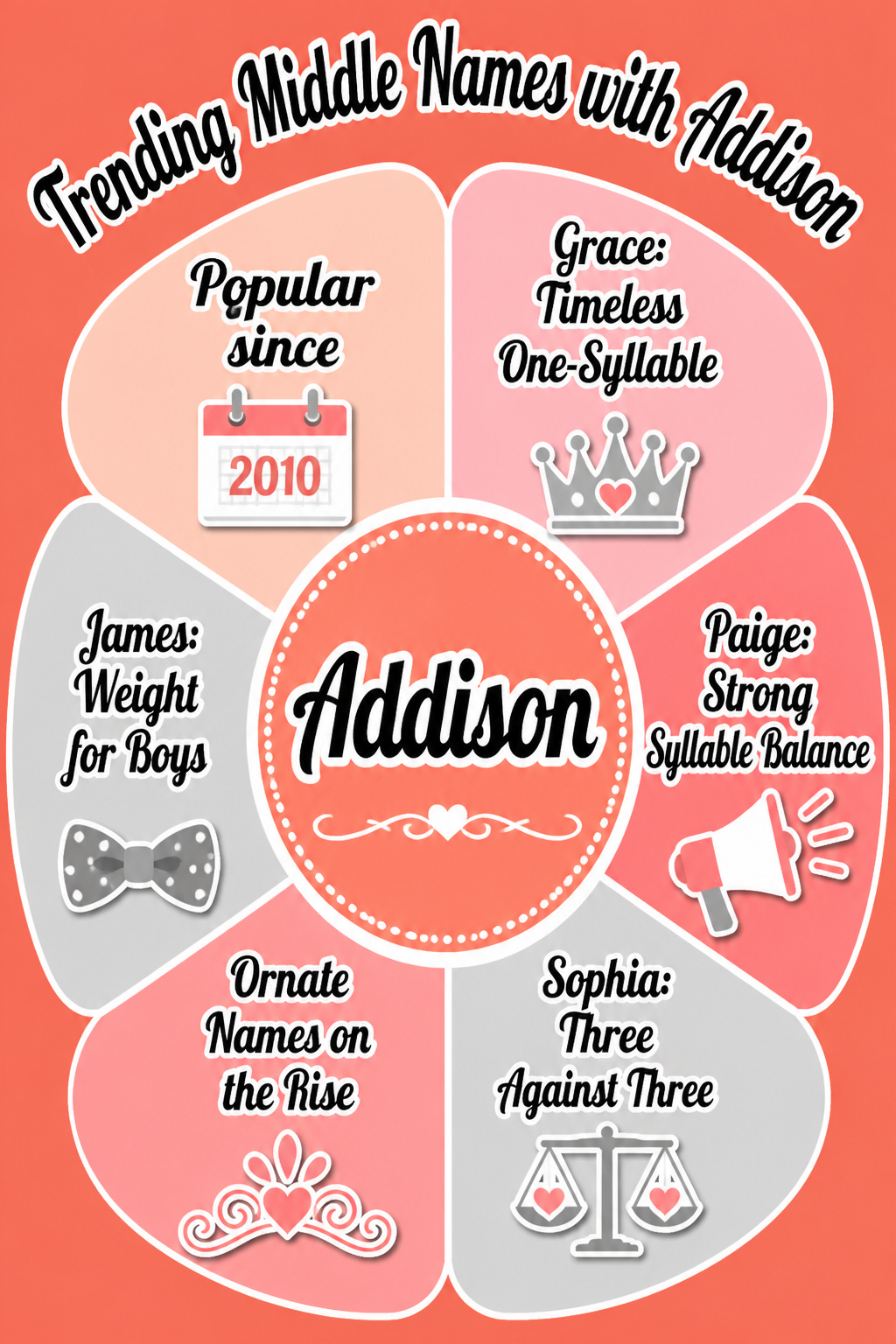
Addison itself peaked around 2010 and remains familiar without being oversaturated, which gives parents some flexibility in the middle spot.
Grace sits at the center of most conversations about current pairings, and for good reason, it is short, singsong with the three syllables of Addison, and reads as finished rather than trailing off.
Paige pulls in the same direction with a single strong syllable that cuts the line cleanly. Sophia moves the other way, three syllables against three, and the choice between these two rhythms is really the whole decision right now.
A one-syllable middle name like Grace or Paige keeps the name anchored and timeless, something that will not read as a timestamp in twenty years.
Sophia, Elizabeth, Charlotte, or Claire do the opposite work, they widen the name out and give it a more formal register.
Both approaches are popular because both solve a real problem: the first name is so unisex and so contemporary that the middle name has to either ground it or lift it.
I tend to think Grace wins for girls and something like James or Thomas wins for boys because Addison already carries enough softness that the middle spot needs the weight.
But Sophia is the pairing I see most often on birth announcements, so the wider, more ornate choice is clearly having its moment too.
Honoring Family in the Middle Spot

The middle spot sits just out of the way enough to carry weight without making the whole name feel like a statement piece.
Grandmothers’ names slide in naturally there: Ruth and Kathleen both pair cleanly with Addison, giving a three-generation thread that reads as deliberate rather than dated.
I have watched friends wrestle with whether Virginia or Dorothy feels too heavy up front, then relax completely when it drops to position two.
Maiden names work the same trick. A last name that would fight for attention as a first name, like Bronwyn, settles in as texture instead of challenge.
Welsh roots or another heritage choice in the middle lets the family story travel without asking the child to explain pronunciation every roll call.
The first name stays the one they answer to; the middle becomes the quiet footnote they can choose to share or keep.
What I like about this placement is the option it leaves open. Addison Ruth can go by either name later, or by both, or by neither.
The middle spot holds the history while the first name does the daily work.
When Addison Is for a Boy

Addison started as a surname meaning son of Adam, and the -son ending still carries that weight for a lot of people.
Owners on Reddit point out the linguistic oddity of handing a name built from "son" to a daughter, though clearly the wider world moved on: Addison ranks solidly with girls now.
Still, if you are naming a boy, the name lands with a different charge.
A middle that leans masculine can steer the whole thing back toward its origins. Addison James and Addison Cole keep the rhythm tight and the signal clear, both short middles that read male without overworking it.
Addison Grey works a little softer, more neutral, though Grey itself has been drifting toward the center for years. Deciding how much you want to push back against the current assumption is what matters.
A name like Addison Thomas or Addison Clark sounds unmistakably male to most ears; Addison Sage or Addison River keeps the door open.
I tend to think the single-syllable middles do the cleanest work here. They do not compete with the three-syllable first, and they do not add any confusion about which way you meant the name to lean.
That said, if you like the sound of Addison Elliot or Addison Julian, the longer middles still read male, just with more flow.
The choice is whether you want the name to announce itself immediately or let people figure it out.
Frequently Asked Questions
What are some good middle names for Addison?
Mae, Ruth, Rose, Grace, Claire, and Paige are the short classics that pair cleanly with Addison’s three syllables. For longer options, Josephine, Ivy, Eliza, Kathleen, Elizabeth, and Sophia all work well, each giving a different rhythm to the full name.
The best fit depends on whether you want a crisp stop or a flowing formal sound.
How do I choose a middle name for my baby girl?
Say the full name out loud, first, middle, and last, to catch rhythm problems a list on paper hides.
A one- or two-syllable middle often evens the pace with a three-syllable first name like Addison, while a three-syllable middle works if the stress pattern shifts enough to keep the ear interested.
If you have to slow down to say it, the combination is fighting you.
What are some unique middle names for girls?
Zinnia, Calla, and Devika stand out without becoming obscure. Zinnia and Calla carry straightforward flower meanings and show up rarely enough that a child is unlikely to share the combination.
Devika offers Sanskrit roots that formalize a modern first name, though the vowels can clash slightly when said fast, so test it aloud a few times.
What’s a pretty middle name for a girl?
Grace is the default pretty choice for Addison, short and singsong with the three syllables. Rose, Claire, and Mae hit the same note with less frequency.
For something prettier in a formal register, Elizabeth, Charlotte, or Sophia widen the name out and give it more weight on a diploma.
What does Addison mean?
Addison started as an English surname meaning son of Adam. By the time it hit the charts in the 1990s, it read as fresh, modern, and entirely unisex, though the -son ending still carries masculine weight for some people.
Are there boys named Addison?
Yes, though Addison now ranks solidly with girls. For a boy, short masculine middles like James, Cole, Thomas, or Clark steer the name back toward its origins.
Single-syllable middles do the cleanest work; they do not compete with the three-syllable first or add confusion about which way the name leans.