Most of these ideas use what is already in the room or what one parent can carry in a single tote bag: paper plates, construction paper, pretzel sticks, and a string of lights from home.
The few that need more setup, like the hot cocoa bar or gingerbread house station, work best when you know ahead of time which parent can bring a slow cooker or a folding table.
A 32-piece prop set from Amazon keeps the photo booth from becoming a midnight hunt, while pretzel antlers and candy melts turn wafers into reindeer that survive a warm room.
1. Holiday Photo Booth

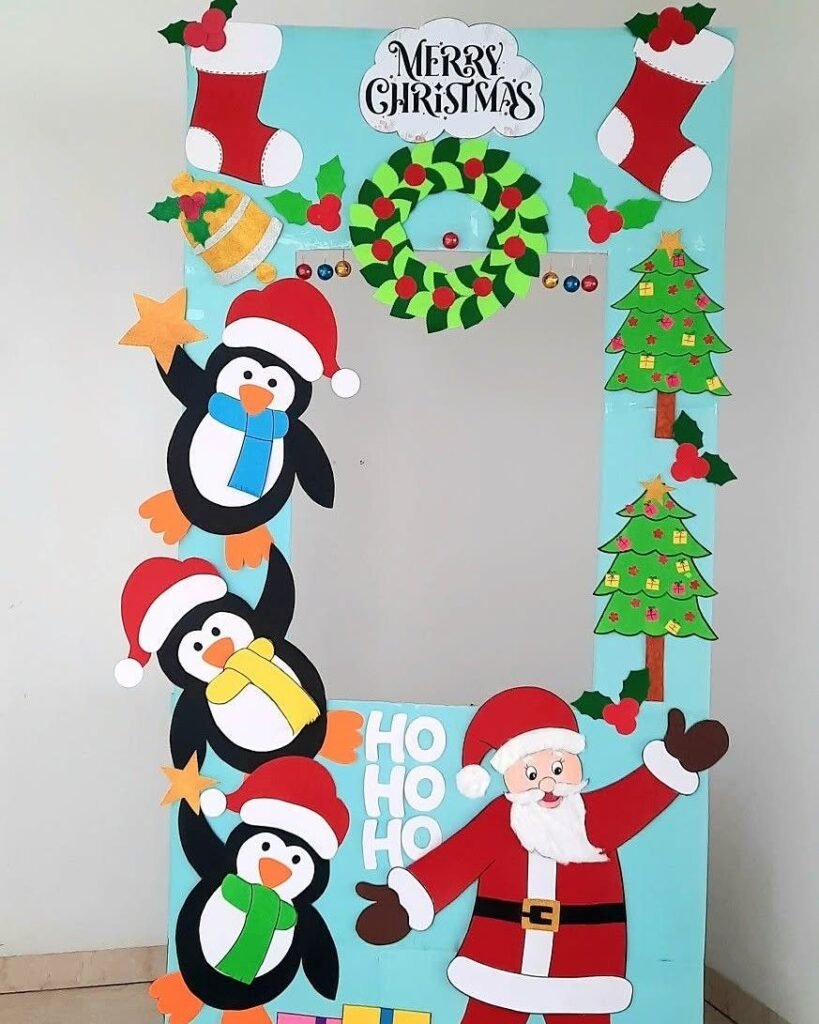
A corner set aside for photos gives students something to take home besides a sugar rush. Cardboard frames in holiday colors work against any wall you have free; the props do most of the work.
Santa hats, reindeer antlers and elf ears cover the basics, and a 32-piece prop set from Amazon keeps you from hunting down pieces the night before.
The setup takes 10 minutes if you pre-tape the backdrop. I’d skip anything that needs plugging in; outlets are never where you want them and cords mean someone has to supervise.
Best for classes where parents follow your social feed; the photos tag themselves.
2. Pin the Nose on Rudolph

Blindfolded kids trying to stick a paper nose on a cardboard reindeer never stops being funny. A taped-down board works if your classroom wall won’t take pins.
Students guide the blindfolded kid with voices or keep quiet and let chaos reign. Both ways work, but teams of 3 keep the line moving.
Red paper circles and tape are enough; nothing needs to stay stuck.
I’d use it as an energy burner between quieter stations, not as the main event.
3. Christmas Tree Card

Construction paper folded in half, a brown rectangle trunk, and green strips layered into a triangle shape: the card builds itself. Older students cut their own branches; younger ones need 16 thin rectangles pre-cut and the trunk glued down first.
Black trees on watercolor washes in pink, blue and purple prove unconventional colors work fine. Metallic gel pens or white crayon add the patterns before the tree goes on.
One class period finishes the basic version. I’d set out the watercolor backgrounds the day before if you want dry paper to work on; damp cards smudge.
4. Hot Cocoa Bar

A hot cocoa bar turns your classroom counter into the main attraction without you cooking anything.
Labeled jars of marshmallows, whipped cream, candy canes and sprinkles let kids build their own; wood surfaces and small chalk labels read as intentional without being precious.
Small cups keep the sugar manageable. Small cups, not mugs, and a ladle with a narrow spout keep the line from becoming a flood.
One teacher runs a math challenge first; students earn their cup by finishing problems.
Cost stays low if you buy toppings in bulk and borrow the jars. Best for upper elementary; younger kids need too much help with hot liquid.
5. Cardboard Gingerbread House Backdrop

Brown craft paper stretched across a wall becomes a gingerbread house tall enough for students to stand inside the doorway.
This scales to whatever wall you have. A single panel behind the reading corner works; so does a full hallway.
The paper is the cost; tape and markers you already own.
I’d build it during art period with student help, not stay late myself. The house lasts through January if you skip the wreath and call it a cottage.
6. Paper Plate Snowman Craft

Paper plates, googly eyes, and pipe cleaners bent into earmuffs: the snowman comes together from whatever’s in the craft closet.
Orange paper triangles for noses and pom-pom cheeks are the details that make each face different; the glue needs drying time, so this is a start-of-party station, not a finish-and-leave one.
Pipe cleaner handles let kids carry them flat; without handles, the plates warp as they dry.
I’d pre-cut the noses for kindergarten and let third graders do their own. Two plates per child if you want a raised edge for the face; one works for a flat mask.
7. Pretzel and Wafer Reindeer Treats

Chocolate-dipped wafer cookies turn into reindeer with pretzel antlers, candy eyes, and a red candy nose.
The wafer base keeps this lighter than a brownie or cake pop, and assembly moves fast enough that a whole class can finish in a single period.
Dip halfway in melted chocolate, press in pretzel halves while the coating is still soft, then attach eyes and nose. A short chill in the fridge sets the chocolate before the kids handle them.
I’d use candy melts rather than baking chocolate; they harden without blooming and survive a warm classroom better.
A parent volunteer with a hot plate handles the dipping, students do the decorating. Skip this one if your school bans all homemade food; the pretzel antlers also rule it out for nut-free classrooms that include pretzels in that policy.
8. Paper Reindeer Face Craft

Brown construction paper forms the head, orange paper shapes the antlers, and a fluffy red pom-pom nose gives this reindeer its personality. Large googly eyes complete the face against a green paper backing.
Tape or glue work; tape dries faster and eliminates the wait. For younger students, pre-cut the antler shapes.
Third graders handle their own cutting, and the maker of this version found that age group rarely saw a reindeer theme before, which kept the activity fresh against the usual snowmen and trees.
A candy cane variation substitutes taped-together canes for paper antlers, though that version is harder to send home intact.
The pom-pom nose is the detail that sells it; pipe cleaner antlers work if you lack orange paper but take more dexterity.
9. Reindeer Cake Pops

Cake crumbs mixed with melted chocolate, shaped into balls, and chilled 20 minutes before dipping become the base for these reindeer pops.
Pretzel antlers and a bright red nose finish the look on white sticks that make them easy to display or bag individually.
The maker of this version uses 1 block of milk chocolate stirred through Christmas cake crumbs for roughly 20 pops, then chills before the final coat. That freezer step matters; warm crumbs slide off the stick.
I’d save these for upper elementary. The chilling, dipping, and detailed face assembly need more patience than most kindergarteners have, and the per-student cost runs higher than pretzel wafers or cookies.
A room mother with cake pop experience changes the math; without one, this becomes a demonstration rather than a hands-on station.
10. Snowman Cup Stacking Game
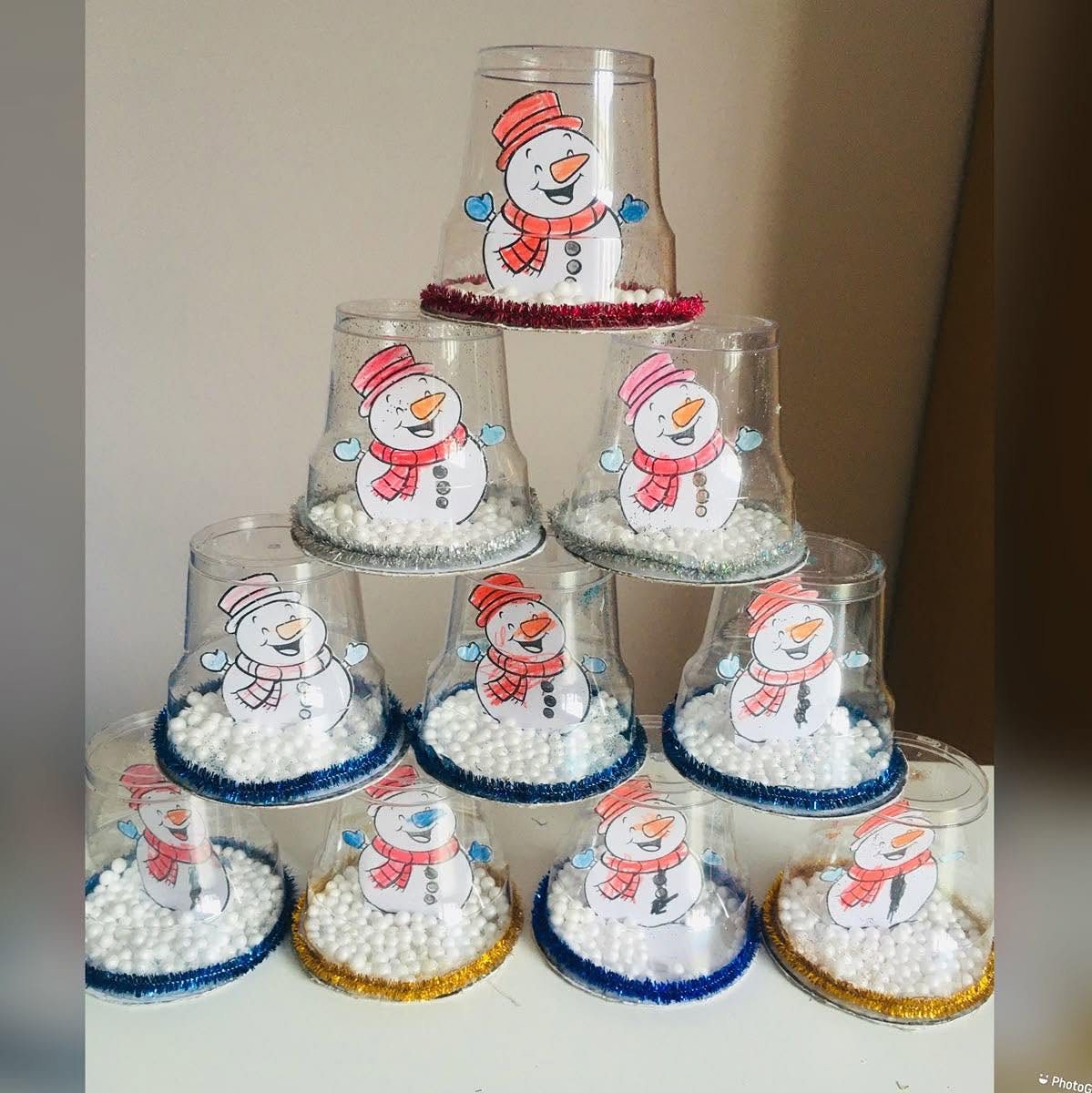
Clear cups inverted into a pyramid, each holding a snowman cutout and faux snow, create a target for stacking competitions or toss games.
The snowman inside is decorative; the game is structural. Students race to build the pyramid fastest, or throw soft "snowballs" at a completed stack to knock it down.
A naming template that turns initials and birth months into snowman names adds a literacy layer if you want one.
Six cups and large white pom-poms work for a simpler knockdown version with younger kids. The full pyramid needs a flat surface and some floor space; I’d clear a desk rather than use carpet, where the cups sink and wobble.
Glitter inside the rim, not loose, saves your custodian’s sanity.
11. Paper Snow Globe Craft

A drawn snow globe frame on black paper contains layered cutouts of a pink house, green pine trees, and a crescent moon, with white paint splatters for falling snow.
The black background makes the colors read as night, which ordinary white paper cannot do.
Construction paper in varied weights layers better than all one thickness; the house pops forward against flatter trees. White acrylic splattered from a stiff brush gives denser snow than a toothbrush, though either works.
I’d assign the paint step first and let it dry while students plan their scene.
This suits 2nd grade and up. The cutting is detailed, and the composition decisions need spatial sense younger kids lack.
A simpler version omits the globe frame and lets the scene run to the paper’s edge, which trades charm for speed.
12. Individually Bagged Holiday Cookies

Miniature sugar cookies shaped like snowmen, trees, gingerbread figures, and candy canes fill clear bags tied with ribbon for a take-home favor that doubles as decoration until dismissal. The variety in one bag matters more than any single cookie’s detail.
Store-bought iced cookies keep this practical; bakery cases at grocery chains carry them from late November. I’d bag 5 or 6 per student, enough to feel generous without breaking a class budget.
Cellophane bags plus curling ribbon run cheap enough that the per-kid cost stays under a dollar.
Check your school’s food policy first. Some districts allow only commercially packaged items, which this satisfies; others ban all sweets or require ingredient labels.
The individual bagging also helps with contact allergies, since students take only their own. A non-food alternative fills the same bags with holiday erasers or stickers if cookies are ruled out.
13. Fabric Ribbon and Fairy Light Backdrop

Vertical strips of fabric turn a blank classroom wall into a photo spot without a single staple in the drywall.
I loop mine over a tension rod wedged between two cabinets; the weight of the ribbon keeps everything straight, and the lights thread through with no pinning required.
Lace, burlap, and satin in holiday widths work mixed or matched. Battery-powered fairy lights are cheap enough to buy in multiples, and two strands cover the span behind a standard bulletin board.
The strands tangle during storage, so I wind each one around a paper towel tube before boxing.
Best for teachers who want reusable decor that breaks down fast and stores flat.
14. Winter Themed Classroom Bulletin Board

A bulletin board already frames whatever you put on it, which saves the taping and repainting that wall displays demand.
I start with a solid paper background in winter blue or white, then layer the cutouts so kids at the back can still read the main phrase.
The snowman and polar bear stand off the surface on folded cardboard tabs; that shadow makes them visible from desk level. Faux cotton batting works for snow drifts and vacuums off the carpet later.
A kindness challenge tacked to one corner turns the display into a take-home activity for break.
This suits rooms where wall space is tight and the board stays up through January.
15. Wooden Snowman Classroom Decor

Painted wood snowmen have the weight to stand on shelves without tipping, which matters when a full class circulates with elbows out.
I have found paper tags tied with twine make these feel finished; one year I wrote each student’s name on a tag and let them claim their snowman at the party’s end.
If you cannot source wooden figures, the same scale works in cardboard tubes with stuffed fabric bases.
The dowel-stick balancing game from the same theme fits on a desk beside them for early finishers.
16. Gingerbread House Decorating Station

Pre-built gingerbread houses skip the overnight drying time that assembling from kits demands, and at a classroom party that single choice saves the whole activity.
Icing goes into squeeze bottles, not spreaders; preschoolers manage those better and the mess stays on the houses. One house per table works, or individual cookies if the budget runs tighter.
The plaid cloth underneath catches every sprinkle and shakes clean outdoors.
This is the station that needs a wet wipe bucket within arm’s reach. Plan enough time for decorating plus hand washing afterward.
17. Paper Plate Santa Craft

Paper plate Santas cost next to nothing per child and every piece is something I already stock: white plates, red construction paper, cotton balls, glue sticks.
I cut the hats myself from folded paper, 6 at a time, and draw the face with a black marker while kids work on beards.
Cotton balls pull apart for wispy trim or stay whole for a full beard; either reads as Santa from across the room.
For a faster version, swap in pink paper circles for cheeks and skip the cotton entirely. These suit the last stretch of a party when energy drops and sitting down helps.
18. Handmade Snowman Cards

Handmade cards give kids something to carry home that is not sugar, and the snowman format works for every skill level in a mixed classroom.
Glitter paper for the gift boxes adds sparkle without loose glitter to vacuum. A folded card format means they write inside, which stretches the activity and satisfies any writing standards still due in December.
I keep a basket of envelopes at the station so finished cards go home protected.
The card-stacking game from the same source works as a 5-minute filler if the craft finishes early.
19. Teacher Elf on the Shelf Prank

Ms. Jordan’s colleague turned her into a walking Elf on the Shelf gag with a doll, tape, and a handwritten sign threatening classroom secrecy. The whole setup costs less if your school already has an elf circulating in December.
Wear it during morning arrival or leave it on through the party itself; either way, the kids spot it before you want them to.
Tape and a paper sign come off clean at lunch, so the desk goes back to normal before the next class. A safety-pin through the elf’s arm loop works on cardigans but leaves holes.
The prank lands best with teachers who already trade classroom elves or whose students know the lore cold.
If your grade level does not do Elf on the Shelf, this reads as confusing, not funny, and a sweater with a plain felt snowman lands the same visual punch without the backstory.
Planning and Preparation Tips
Send the parent letter 2 weeks out. That gives time for volunteers to clear their schedules and for supplies to arrive without a last-minute Walmart run on December 23.
I ask for 2 parent helpers per station and list exactly what I need: 3 bags of marshmallows, not "some toppings."
Wrapping paper on tables is the cleanup hack I wish I’d found earlier. Discount store rolls are cheap enough that taping them underneath the tables doesn’t feel wasteful, and cleanup means pulling off one layer instead of scrubbing glitter glue.
When the party ends, you peel the whole thing off, sprinkles and all, and the surface underneath is untouched. I use heavier foil styles; thin paper tears when wet cups sit on it.
The pattern matters less than you’d think; kids barely look down once the activities start.
Theme Ideas
The novelty buys you attention you would spend managing behavior under a repeated theme.
Holidays Around the World shifts the party toward social studies without feeling like a bait-and-switch. The prep is front-loaded in research, not decoration, which suits teachers who would rather read than cut out 30 identical shapes.
Winter centers spaced across a full week trade the single chaotic afternoon for 20 short activities with built-in structure.
The December centers format drops any direct Christmas reference while keeping the seasonal energy; districts with strict neutrality rules accept it without modification.
Challenge your class to conduct a survey on re-gifting and graph the results, update a classic Christmas poem and act it out, or research how Christmas is celebrated around the world.
Incorporating Learning
Holiday Bingo adapts to whatever skill your class is currently reviewing. Numbers, letter sounds, sight words, or addition facts fill the squares; the holiday element is only the markers, which can be Christmas candy if your policy allows edible counters.
The game mechanics stay identical, so you lose no time to explanation.
Station rotations let you slip writing standards into card-making or math into the hot cocoa bar. The students see a party, you see standards met before break.
Managing Student Behavior
Post the rules where students can see them before the party starts, not after the first conflict. Mine are short: stay at your station until rotation, one treat per station, voices at table level.
The specificity matters; "be good" is too vague to enforce in heightened energy.
I assign each parent volunteer 1 rule to watch, not the whole list. One manages the line at the cocoa bar, another checks that craft supplies stay on the paper.
The distribution keeps any single adult from hovering or checking out.
Clear rotation signals prevent the bottleneck that triggers most behavior issues. A chime, a song clip, or a lights flicker means move; students who know the cue in advance transition faster than those waiting for shouted instructions.
Frequently Asked Questions
What are some easy holiday party ideas?
Low-prep stations work best: a photo booth with cardboard frames and props, pin the nose on Rudolph, paper plate crafts, and a hot cocoa bar with labeled jars of toppings.
Keep the setup under 10 minutes per station and skip anything that needs outlets. Store-bought shortcuts like pre-iced cookies and pre-built gingerbread houses keep you from staying late the night before.
How can I organize a classroom Christmas party?
Run everything in rotating stations so kids stay busy and the line keeps moving. One station burns energy, like pin the nose on Rudolph; another sits kids down, like a paper craft or card-making.
I ask parent volunteers to handle the hot plate or cocoa ladle so I stay free for crowd control. Communicate the food policy early; some districts ban homemade items or require ingredient labels on everything.
What activities can I include in a holiday party?
Mix crafts, games, and food so energy rises and falls instead of staying at one pitch. Paper reindeer faces and snow globe crafts suit art periods; cup stacking and Rudolph games burn off excitement between quieter stations.
A zero-prep backup like a winter story or a card-stacking filler saves the schedule when something finishes early.