
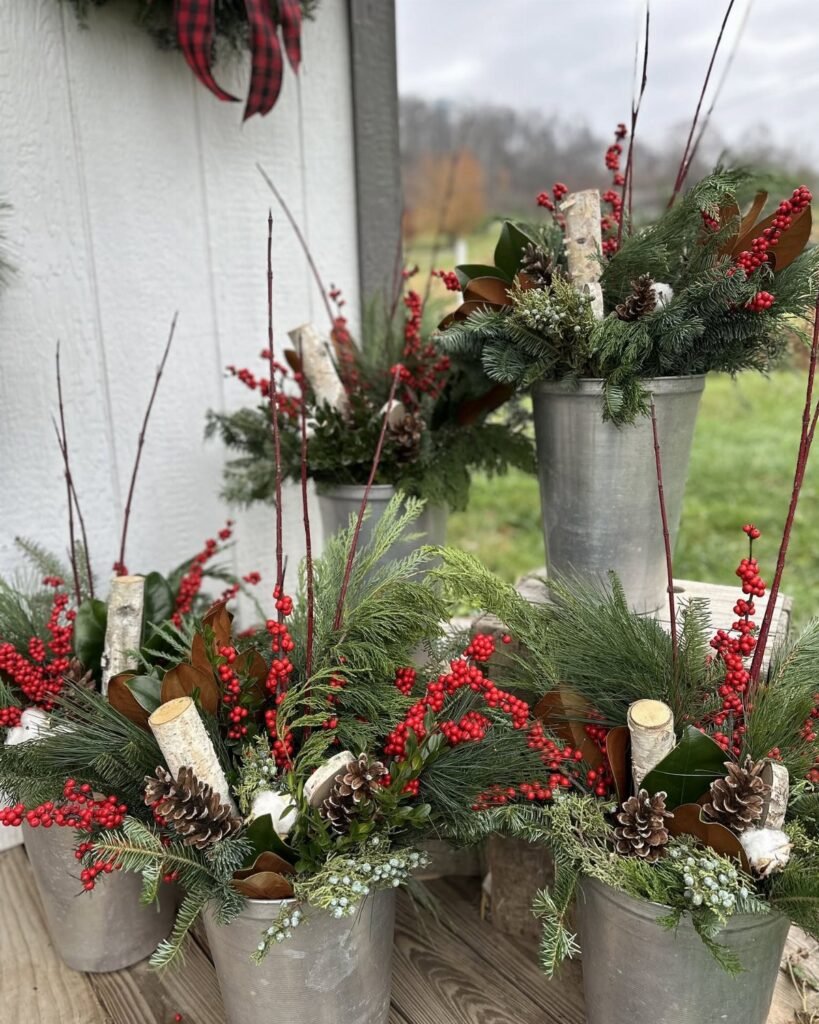
Christmas porch pots run from a $10 grapevine wreath stuffed into an urn to a weighted classical planter dressed with faux peonies and camellias, and the deciding factor is what the reader already owns: summer soil and a black planter, a garden urn, or access to a southern magnolia and a can of white spray paint.
The posts below lean on birch branches as the spine, then bring in gold orbs, fairy lights, and frosted pinecones with epsom salt to fill out the shape.
1. Outdoor Planters

Summer planters left outside through November are already halfway there. The soil holds whatever you push into it, so three to four sets of birch branches become the spine, standing tall enough to clear the rim.
Around them, evergreen picks, berry picks, and pinecones fill the middle zone where annuals once sat. A red ornament or small decorative tree on top reads as Christmas from the sidewalk.
The black planter against brick needs that red element; without it, green and brown disappear in low winter light. Store-bought picks with wired stems push in easiest; foraged branches need sturdier holes poked first with a dowel.
I’d keep the summer soil rather than swapping it. Frozen dirt anchors everything heavier than anything fresh.
2. Pinecones

Pinecones do the job that excels at: hiding the mechanics. Tucked between branches or settled on soil, they cover bare spots where stems cross and soil shows, and the ridged surface catches light differently than flat needles.
Scale matters more than count. A planter at knee height wants cones the size of a fist; smaller ones read as debris.
Balance two large cones against red ornaments because the eye needs a third texture, something matte against all that gloss.
Foraged cones need a low, slow bake to evict residents before they go into the pot. Store-bought are clean but uniform; I mix both, the purchased ones placed deliberately, the found ones scattered as if they fell there.
Wet weather darkens them; that is the look, not a problem.
3. DIY Winter Porch Pot

A grapevine wreath stuffed into an urn takes 10 minutes and costs grocery-store prices. The wreath forms the base; live greens wired on top give it height and the smell that artificial picks cannot fake.
Pinecones nest into the grapevine gaps.
Choose a wreath dense enough to stand without soil. Loose grapevine collapses; tight weave holds its cylinder.
Set it in the urn, fluff the wired greens upward, and the thing stays put through freeze and thaw.
This version lasts past New Year’s, still reading as winter rather than expired Christmas. I’ve left mine out until Valentine’s Day more than once.
Birch logs and a plaid bow dress the pot up one step; skip the bow for January, keep the rest.
4. Evergreen Boughs

Cedar, spruce, pine, hemlock, and cypress each behave differently. Cedar drapes soft and flatters round shapes.
Spruce holds stiff, good for height. Pine needles cluster longer, filling volume fast.
Hemlock fans out at the tips; cypress hangs in curtains. Mixing two or three gives the planter movement that a single type flattens into a hedge.
Hardware stores sell bundles cheap this time of year, enough for one large urn or two small. Property owners with trees can cut their own; the branches you want face outward on the tree, already shaped by light.
Indoor boughs need daily misting to last. Outside, cold does the preserving.
Pampas grass is a smart addition for structure; it stays upright when wet evergreens droop.
5. Birch Sticks and Gold Accents

Gold against black and green reads expensive without being expensive. A single large orb works because it is singular: one statement piece instead of several competing ones.
A cluster of small gold balls would read as clutter; the lone sphere holds the eye.
The ribbon trailing from it is optional. Without, the look is modern; with, traditional.
Bare branches mixed in keep it from feeling too decorated, too soon.
I’d add them for a house set back from the street, where the detail needs help at distance. Close-up porches need less.
6. Fairy Lit Evergreen Planters

Fairy lights turn porch pots into something the neighbors notice after dinner, not just in daylight. Warm white, not cool; the yellow cast agrees with evergreens where blue-white fights them.
Battery-operated strings with timers solve the extension-cord problem for renters or porches without outlets.
Wrap lights through the branches rather than around the urn lip. That takes more string, more lights per planter for density, but the glow distributes through the arrangement instead of lining its edge.
Red berries catch the light and read as lit themselves.
Three to four sets of birch branches still form the architecture. Build the structure first, add lights second, then adjust greens to hide the wire.
The timer lives in the soil, wrapped in a plastic bag against moisture.
7. Ornate Urn with Red Florals

A dark classical urn reads expensive even when it is not, and the weight of it keeps an arrangement upright through wind that would tip a plastic pot.
The reader who already owns one garden urn has the hard part done. The rest is layering: faux peonies or camellias in deep red, then pine boughs stuffed around them to hide where the stems end.
Red berries on wire picks fill gaps, and pinecones sit on top where they catch light. A skewer poked through each pine cone and into the soil below stops it rolling off in a storm.
The wooden skewer trick works for anchoring wreaths too; a grapevine wreath wired to a skewer and driven into the soil becomes a backdrop behind the flowers, matching any wreath already on the door.
This one suits the host who wants coordination without symmetry: the urn carries the formality, the red carries the theme, and the exact pieces inside can change year to year.
8. Blue Container with Magnolia Leaves

Blue reads as winter without needing snow, and a dark container shows less dirt than terracotta or white.
Magnolia leaves are the move here: thick, glossy, and brown on the back where most evergreens are pale. That two-sided color does the work of two plants.
Pack them heavy so the waxy surfaces catch light, then tuck dark blue berries and pinecones into the gaps where the leaves meet.
The blue-on-blue of berries against container needs contrast to register; the brown backs of magnolia leaves provide it, and the pale wood of pinecones seals the palette.
Fresh magnolia branches last weeks in cool weather, and the stems are stiff enough to stand without a frog or foam if the pot is deep.
This suits the reader with a southern magnolia nearby and a porch that gets afternoon shade, where glossy leaves still read rather than going black in low light.
9. Red Berries and Frosted Pinecones

Frosted pinecones are the one detail that signals "decorated" rather than "piled branches," and they cost little if you make them yourself: white spray paint held at distance, then a dusting of epsom salt while it is tacky.
Black rectangular planters keep the look modern and read against brick without competing. Pack evergreen boughs to the same height on both sides of a door; asymmetry here looks accidental, not artistic.
Red berry clusters wired to stakes push forward where the green goes flat, and frosted pinecones rest on top, glued to short picks if the arrangement is tall enough to tip them.
Gold accents read as bells or small ornaments; they catch porch light after dark, which plain greenery does not.
This is the default choice made specific: the reader who wants their porch to look finished in an hour, with materials from any craft store, and to spend as little as possible for the pair.
Use of Artificial Elements
Artificial picks solve the problem live greens create by late January. A cedar bough turns bronze after 3 weeks of freeze-thaw; a plastic cedar pick stays the same color until you store it.
I would wire artificial picks to birch branches for a structure that lasts the season without browning.
Ornaments are the other place artificial wins. Glass breaks once the temperature drops hard enough; plastic or shatterproof versions survive the same drop.
A single large red plastic ball reads the same from the sidewalk and shows up cheap at discount stores.
You lose the smell. Nothing artificial duplicates pine resin in cold air.
I’d use live greens for the first 2 weeks of December, swap to artificial after the scent fades, and keep the same structure underneath.