Letter M show and tell ideas run from free pen-and-paper doodles to googly eyes and up to a share bag of candy, with the deciding factor being how much time you have between the crumpled backpack notice and the classroom deadline.
Masking tape peeled off after tempera paint dries turns even wobbly preschool brushstrokes into intentional-looking art for a monster project.
1. Letter M Monsters

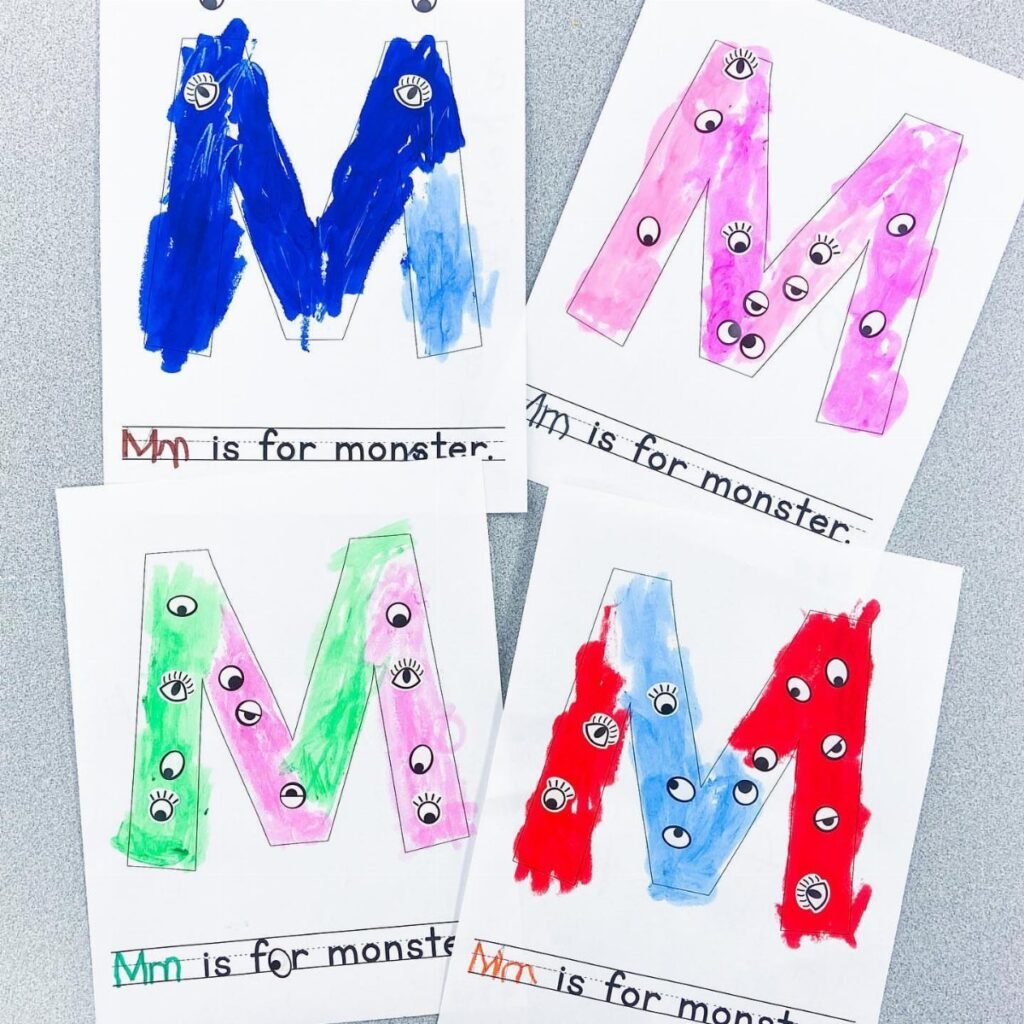
Letter M monsters turn a simple cutout into something preschoolers actually want to show the class.
I like this one because the materials cost almost nothing and the mess is manageable: construction paper, tempera paint in 2 or 3 bright colors, and a sheet of googly eyes from the dollar store.
The tape-resist technique from some art teachers I follow works beautifully here; lay masking tape in an M shape on cardstock, let kids paint over it, peel the tape once dry, then stick on eyes and draw teeth.
The monster angle means even wobbly paint blobs look intentional. Best for preschoolers who can handle stickers without eating them.
Skip the cotton-ball version floating around online; it sheds for weeks.
2. Letter M Drawing and Doodling

A grid of different M styles gives kids permission to treat letters as shapes rather than homework.
I keep a doodle sheet like this in my bag for restaurant waits and car rides; no materials beyond a pen and whatever paper is nearby.
Show variety upfront: block, bubble, wavy, one with a tiny monkey clinging to the stem. After they copy a few, most preschoolers start inventing their own.
Costs nothing, travels anywhere, and fills whatever time you have depending on interest. The downside is zero finished product to send home; pair it with a blank notebook if parents expect evidence.
Start in the middle, little line down, slide back up, curve around, slide back up, curve around, lowercase m, great job today, practicing sounds and learning a new letter.
— PBS
3. M&M’s Candy Pack

A snack-sized bag of peanut M&M’s is the easiest M entry in the room, and I have used it more than once when the show-and-tell notice came home crumpled in a backpack that morning.
The yellow bag photographs well, the color-coded candies let you count and sort by shade, and the letter on every piece is literally the one you need.
For teachers, a single share bag runs cheap and feeds a whole table for a sorting activity; for parents, one fun-size pouch per child satisfies the assignment without sending anyone home sugar-shocked.
I’d save this for the child who freezes at the speaking part; unwrapping candy buys a moment of confident action while they find their words.
Engaging Children in Learning
Hands-on work keeps a preschooler in the room longer than any worksheet. When a child builds the letter M from tape and paint, the shape stays in muscle memory, not just visual memory.
I think of it as paying now for retention later: 10 minutes of sticking googly eyes beats 3 minutes of tracing a line.
The sorting with M&M’s works the same way; fingers moving candies into color piles keeps the brain awake while the mouth says the sound.
Doodling hits a different need, filling dead time with something that still points back to the letter.
None of these need a table or a right answer, which matters when you’re working with a kid who has already sat still for circle time.
Importance of Letter Recognition
Letter recognition runs underneath every other reading skill. A child who can spot M in a lineup of shapes has the start of connecting that shape to the hum of "mmmm" they have made since infancy.
The show-and-tell format gives that connection a social boost; saying the sound to classmates locks it in differently than saying it alone to a parent.
I like that the list ideas all keep the focus on one letter rather than rushing through the alphabet. A whole week on M means the shape has time to become familiar before the next one crowds in.
The M&M’s help here too, since every candy repeats the same symbol the child is trying to learn.
Using Books for Learning
Books where M words carry the story give children a reason to hunt for the letter beyond the lesson.
A moose in a plot, a muffin on a page, a monster under a bed; these stick because the child already wants to know what happens.
I would read the book once for the story, then a second time letting the child call out every M they spot.
The mini books from some printable sets fold small enough to send home, which matters when parents ask what happened at school.
For a child ready to trace, the reading strips with pictures to match give a next step that still feels like a game. Humming a tune before you start can settle a group that arrived wound up from recess.
Incorporating Movement
Kinesthetic work matters most for children who cannot sit through a whole book. Rolling Play-Doh into an M shape lets the whole arm participate in forming the letter, not just the fingers holding a pencil.
I have seen kids who ignore a tracing sheet spend 10 minutes getting a dough M to stand upright. The movement itself becomes the memory.
For a show-and-tell twist, a child could demonstrate the rolling technique to the class rather than bringing a finished product.
The color matching from some activity sheets adds a layer, though I would skip it if the child just wants to build. The body learns the shape; the color does not need to be right.
Frequently Asked Questions
What are some common items that start with the letter M?
Monkey, muffin, and moon are classic show-and-tell picks, along with mitten, mirror, magnet, and mug.
For a letter M day, I like objects that preschoolers can describe in a sentence or two, which helps more than a flash card they just name.
A monster craft turns a simple letter cutout into something kids actually want to talk about.
What are some good kids books that start with the letter M?
If You Give a Moose a Muffin and The Monster at the End of This Book are the two that come up most often for this age group.
A book works well for show and tell because the child can hold it up, say whether they like the pictures or the story, and pass it for the class to see the cover.
I’d check the school rules first; some teachers prefer objects over books since the library already handles reading time.
What are some activities for preschoolers that teach the letter M?
Tape-resist monster paintings, doodle grids with different M styles, and M&M sorting by color all work for this age group. None of these need special setup, which matters when the notice comes home the same morning.
What are some fun games about the letter M?
Hidden picture pages with M words like meditation or moped, plus monkey and music mazes, give kids letter recognition practice without feeling like worksheets.
Movement games where children act out M words, marching like a mouse or miming a mermaid, burn energy while reinforcing the sound.