These January coloring pages run from a simple penguin in a pink scarf to polar bears under northern lights, so the deciding factor is how much blank space your colorist can handle before stalling.
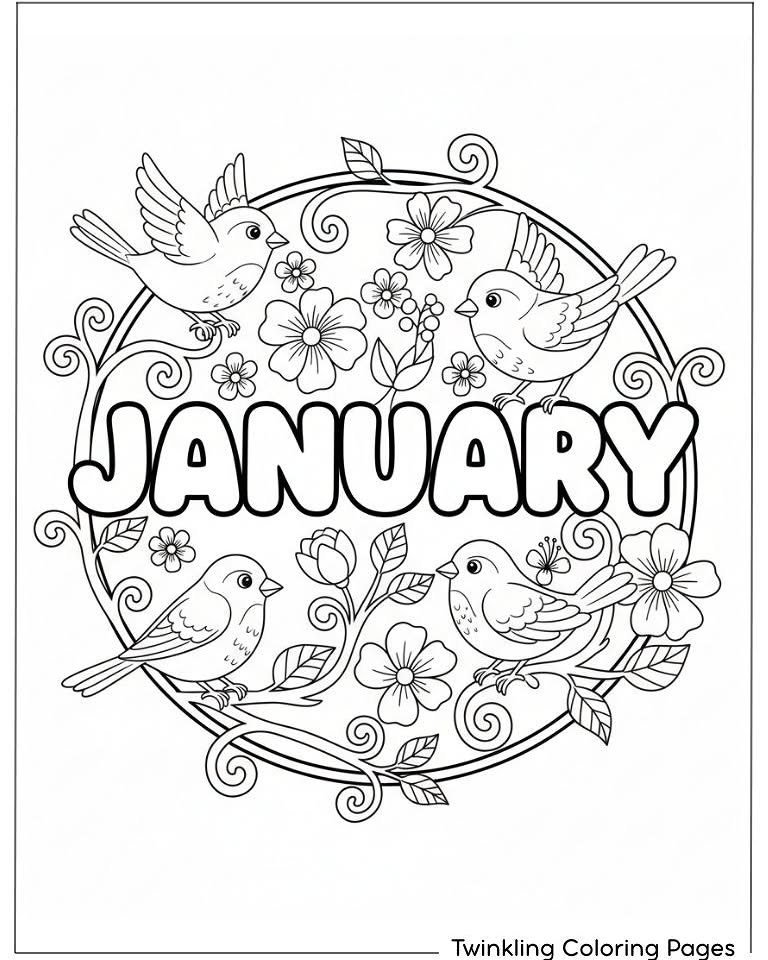
A bubble-letter "JANUARY" with vines fills itself in; a snowy hill with kids sledding asks the hand to keep going.
1. Penguin Coloring Page
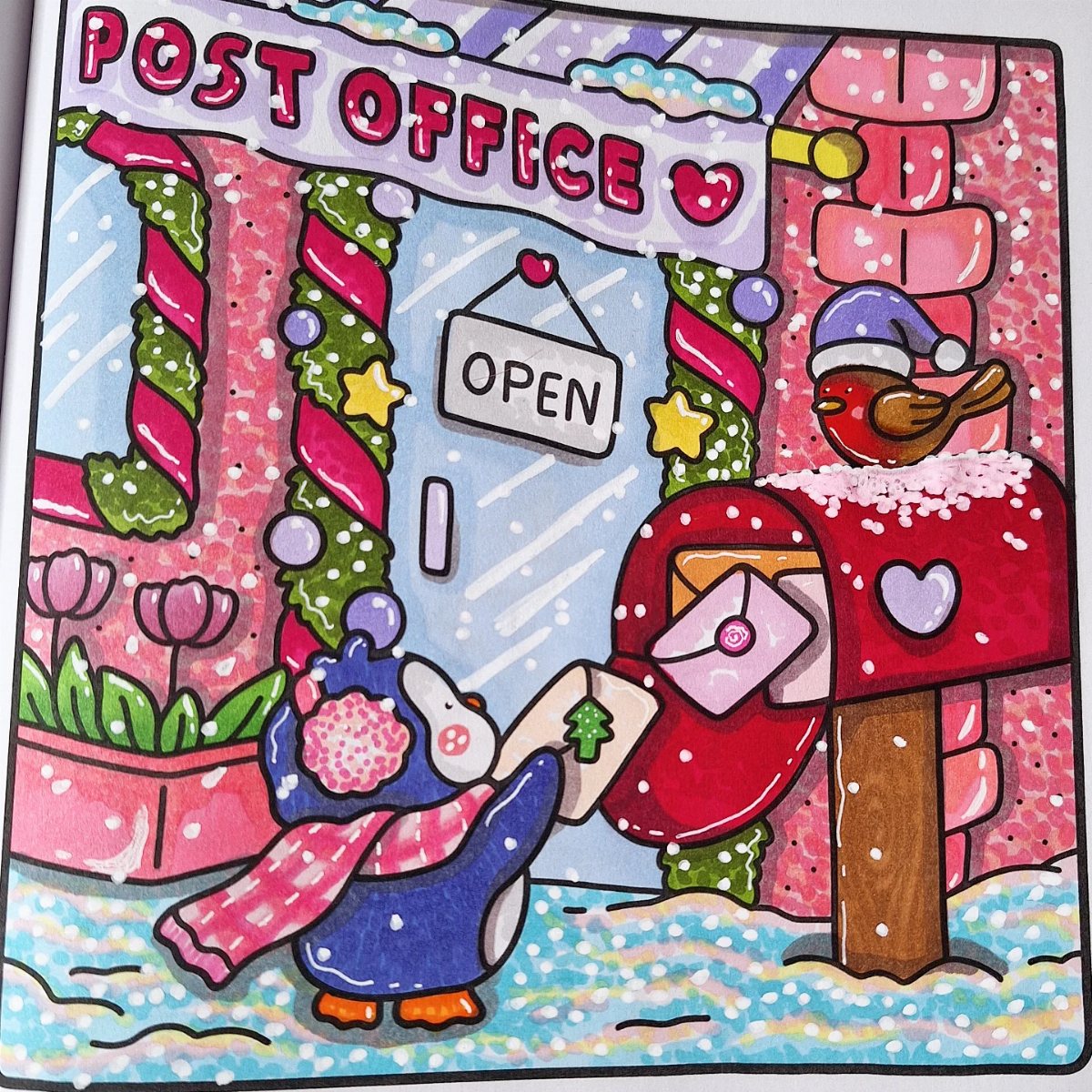
A penguin in a pink scarf mailing a letter at a snowy post office gives kids a small story to finish with their own colors.
The earmuffs and the "OPEN" sign are details they will notice before they pick up a crayon, which makes this one work for children who stall at blank pages.
I would hand this to a kid who needs a scene rather than a character alone. The post office setup also suits a January unit on community helpers or mail-themed activities.
2. Snowman Coloring Page

Two girls building a snowman with a wooden sled nearby turns the usual single snowman into something happening between people.
The pine trees and forest setting give older colorists more area to fill with texture, while the figures stay simple enough for younger hands.
Markers suit this better than crayons if you want the scarf and buttons to pop against all that white; colored pencils work if you want to shade the trees.
I would use this for a snow day activity bag or a classroom calm-down station after recess.
3. Kids Sledding Down Snowy Hills

The inflatable tube matters here: it reads as modern and playful, not the wooden sled of picture books, which helps this page land with kids who actually sled now.
The cottages in back give a place for adults or older siblings to add detail while younger ones focus on the figure.
I would print this on heavier paper if you are using markers; the sky area is large enough that bleeding becomes a problem on standard copy paper.
4. Snowy Hills, Trees, and Cozy Cabins

A log cabin with snow-heavy pines and a winding path invites slow coloring rather than quick completion.
The fence posts and the roofline’s angles give you natural places to shift from light to dark blues, which is how I would handle this one: start with the sky, work down to the hills, save the cabin warmth for last.
This page trades the action of sledding or snowmen for stillness, so it suits a reader who wants January coziness without characters to draw.
The line weight is consistent throughout, so fine-tip pens or gel pens work without the thick-outline problem that frustrates adult colorists on simpler pages.
5. January Floral Bubble Letter Page

"JANUARY" in bubble letters surrounded by vines and a smiling sun splits the difference between a word search and a coloring page.
The sun is the odd element out in a winter month, which I would treat as a prompt: color it pale yellow like a January afternoon that never really warms up, or go bold orange if you prefer the contrast.
The floral vines frame the word without crowding it, so this works for a bulletin board header or a calendar cover.
Bubble letters are forgiving for kids still learning pressure control; the vines give confident colorists something intricate to return to after the big shapes are done.
6. Winter Wildlife Coloring Page

An elk in a mountain forest is the most detailed line drawing here, with antler tines that will test fine motor skills and patience.
The faint watermark visible on some prints does not affect coloring, though I would check my print before handing it out: on cheaper copies the watermark can darken enough to read as part of the drawing.
This page suits older kids or adults who want winter scenery without the cute factor of penguins or snowmen.
The elk’s size relative to the trees also makes it a quiet lesson in perspective, if you are using these pages for more than filling time.
7. Polar Bears Under Northern Lights

Polar bears under northern lights sit at the far end of the January mood spectrum, trading snowflakes and mittens for something quieter and stranger.
The adult and cub pairing gives younger kids an emotional anchor they can narrate while they work, and the aurora bands invite older ones to layer colors until the sky looks like it is actually glowing.
Oil pastels or gel pens handle the aurora better than standard crayons because they let colors melt into each other without going muddy.
A black or deep navy page makes the lights pop, though a white page with a dark sky drawn around the bears works fine too and costs nothing extra.
This one suits kids who have already colored enough snowmen this month and need a scene that feels less like a greeting card and more like a window somewhere cold and real.
The cub adds enough warmth that it does not read as lonely, which matters for bedtime coloring.
Benefits of Coloring
Coloring builds the hand strength and control that later shows up in handwriting, not through drills but through staying inside lines that matter to the colorist.
A child choosing whether the January sky reads as gray or pale blue is practicing decision-making with low stakes, which is where confidence starts.
The focus required is active, not passive; the page demands enough attention to keep a kid seated but not so much that they abandon it.
For children who struggle with stillness, a coloring page with details to notice, like the penguin’s earmuffs or the post office sign, gives their eyes a path to follow.
Creativity here is bounded, which is the point. The drawing exists; the child supplies the vision.
That combination of structure and choice is what makes coloring a reliable reset activity after school or on snow days.
Educational Use of Coloring Pages
In a classroom, January coloring pages work as anchor activities between transitions or as the calm-down portion of a winter unit.
A teacher building a community helpers theme can hand out the penguin post office page and ask kids to name what the postal worker does before they color, so the page becomes discussion material, not just busywork.
For quiet time after recess, the snowman or sledding pages give enough narrative detail that children settle into them independently.
A teacher can keep 12 printed sheets in a binder or busy basket and pull one out as needed, which saves planning time during the short January days when indoor recess is frequent.
Sharing and Usage Rights
Most free coloring pages carry a personal-use-only restriction, so check the terms before handing them out at a classroom party or posting finished pieces online.
That covers home printing, classroom handouts, and activity bags; it does not cover republishing the image on another site, selling it as part of a product, or including it in a downloadable packet you distribute yourself.
The right way to share these with another parent or teacher is to send the link to the original page where you found them.
The creator keeps control of the file, the visitor counts help them continue offering free work, and the person you share with gets any updates or corrections.
If you need pages for a commercial purpose, like a paid event kit or a subscription box, look for listings that explicitly include a commercial license.
Free personal-use pages and paid commercial licenses are separate products; assuming one covers the other can create problems after you have already printed and distributed.
Printing Tips
Standard 8.5 x 11 inch paper handles most of these pages fine, but the choice between "Fit to Page" and "Actual Size" matters.
"Fit to Page" shrinks the image slightly to guarantee nothing cuts off at the margins, which is the safer default for home printers. "Actual Size" risks losing edge details if your printer’s margins are narrow.
For the sledding or northern lights pages with large sky areas, cardstock or heavier paper prevents marker bleed that turns a pale winter sky into a saturated mess.
The log cabin page also benefits from heavier stock if you are using gel pens or fine-tip markers, since the consistent line weight invites those tools.
Check your first print before running a full classroom set.
Frequently Asked Questions
Are these coloring pages free?
Every page downloads and prints at no cost. I do not charge for any of the printables on this site, including the January collection.
What age group are these coloring pages suitable for?
The pages range from simple bubble-letter designs that suit preschoolers still learning pressure control to detailed elk drawings with antler tines that test older kids and adults.
The descriptions note which suit which ages: penguin and bubble-letter pages for younger hands, winter wildlife and northern lights for more patient colorists.
Can I use these coloring pages in a classroom?
Yes. Heavier paper holds markers better; standard copy paper lets large sky areas bleed through.